
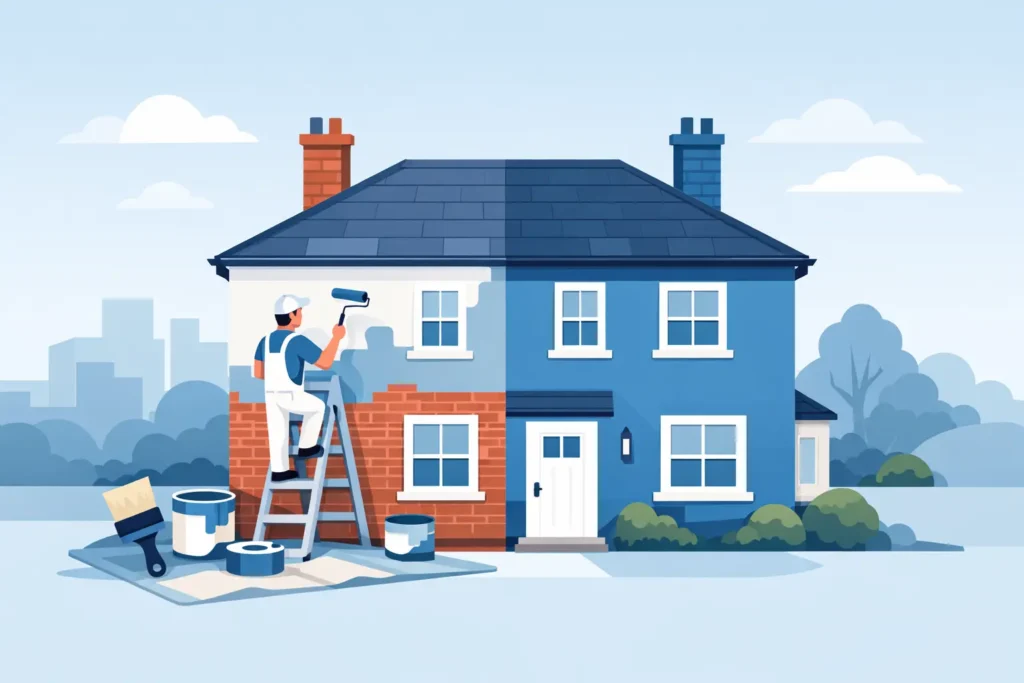
If you are asking how much does it cost to paint a semi detached house?, you are usually not looking for a vague range. You want to know what drives the number, what is included, and whether the quote will stay fixed once work starts. That is the real issue for most homeowners – not just price, but price with clarity.
For a semi-detached house, exterior painting costs often land anywhere from a few thousand dollars for a straightforward refresh to significantly more for larger homes, difficult access, heavy repairs, premium coatings, or full interior and exterior repainting together. The wide range exists for a reason. A semi-detached property is not priced like a standard apartment, and it should not be.
How much does it cost to paint a semi detached house?
The fastest honest answer is this: the cost depends on size, condition, access, paint system, and scope. If you are painting only the exterior walls and trim, the price will usually be lower than a full project that includes interior walls, ceilings, doors, gates, boundary walls, and touch-up repairs. If the home has high elevations, peeling paint, water stains, hairline cracks, or hard-to-reach side passages, labor and preparation go up.
That is why two semi-detached homes on the same street can receive very different quotations. One may only need washing, minor patching, and two fresh coats. The other may need scaffold access, extensive scraping, sealer, crack treatment, and weather-resistant paint on multiple surfaces.
As a practical benchmark, many contractors price semi-detached house painting in one of three ways: by total built-up area, by surface area, or by project scope after onsite assessment. For homeowners, fixed project pricing is usually the easiest to manage because it removes uncertainty. You know what is covered before the crew starts, and you are not left counting surprise add-ons halfway through the job.
What affects the cost most
The biggest pricing factor is not the paint itself. It is preparation.
A house with sound existing coatings, clean walls, and only minor patching can move quickly. A house with flaking paint, damp spots, mold growth, or visible cracks needs more labor before a single finish coat is applied. Surface prep is what separates a paint job that looks good for a few months from one that holds up properly.
Property size also matters, but not just in square footage. Semi-detached homes often have more exterior exposure than terrace-style properties, which means more wall area facing sun and rain. More exposure usually means more weathering, and more weathering means more prep, sealer, and coating requirements.
Access is another major variable. If painters can work safely using ladders and standard equipment, costs stay more controlled. If the house has double-height facades, tight side setbacks, steep roof lines, or awkward rear access, the contractor may need additional manpower or temporary access systems. That adds cost, but it also reduces risk and improves finish quality.
Then there is the paint system. Not all paints are priced the same, and not all are suitable for the same surfaces. Standard emulsions, premium washable interior finishes, elastomeric exterior coatings, anti-fungal systems, and specialty sealers all carry different price points. A lower quote may simply reflect a lower-spec product lineup.
Exterior only vs full house repainting
When homeowners compare estimates, this is where confusion starts. One contractor may quote for external walls only. Another may include trim, gates, ceilings, boundary walls, and patch repair. The total looks different because the scope is different.
If you are planning an exterior-only repaint, expect the quote to center on washing, protection, scraping loose paint, patching defects, sealing, and applying the agreed number of coats. This is usually the right choice when the inside of the home is still in good shape and the main concern is curb appeal or weather protection.
If you are doing a full-house repaint, the scope expands quickly. Interior walls, ceilings, bedrooms, living areas, staircases, bathrooms, service areas, doors, and sometimes built-in surfaces may all be included. This is a larger operation, but it is often more cost-efficient to complete everything in one mobilization rather than splitting the work across separate jobs.
Why cheap quotes often become expensive
A low starting price can look attractive until the exclusions appear.
Some contractors quote only for paint application, then charge extra for crack filling, sealer, mold treatment, furniture protection, cleanup, or additional coats. Others use vague wording around the paint brand or series, which makes it hard to compare one proposal against another. If the quote does not clearly spell out surface prep, number of coats, paint type, and included repairs, the final bill may not resemble the original number.
This is why process matters. A proper painting contractor should assess the site, explain which paint ranges fit the home, identify visible defects, define the prep work, and confirm the price before mobilization. That is how you keep the project efficient and predictable.
A simple way to estimate your budget
If you want a realistic budget before requesting an onsite quote, think in layers rather than one lump sum.
First, define the scope. Is it exterior only, interior only, or both? Second, assess condition. Are the walls generally sound, or are there cracks, peeling, and moisture marks? Third, consider finish level. Do you want a standard refresh or premium long-term protection? Fourth, factor in access. Is the whole property easy to reach safely?
Once you answer those four points, your budget becomes clearer. A straightforward repaint with good wall condition and standard coatings will usually stay in the lower bracket. A large semi-detached house with extensive prep and premium products will move higher. The key is getting a quote that matches the actual condition of the home, not a generic online estimate.
How a professional quote should be structured
For a semi-detached property, the best quotes are detailed but easy to read. You should be able to see what surfaces are included, what prep is required, what paint system will be used, how many coats are applied, how long the work is expected to take, and whether warranty coverage applies.
That level of clarity matters because house painting is not just about color. It is a maintenance project. Done properly, it protects walls, improves appearance, and saves you from repeat work too soon. Done cheaply, it can leave you paying again far earlier than expected.
A structured contractor will also talk through scheduling. For occupied homes, speed and organization are part of the value. Homeowners do not want open-ended work dragging through the week. They want a team that protects surfaces, completes prep correctly, paints in a controlled sequence, cleans up, handles touch-ups, and hands over the property without forcing the owner to manage every detail.
How much does it cost to paint a semi detached house if you want premium results?
Premium results usually mean more than expensive paint. They mean better preparation, a more suitable product match, cleaner lines, stronger coverage, and a finish that holds up longer under weather and daily wear.
If your goal is long-term durability, it often makes sense to spend more on the exterior system where sun and rain do the most damage. For interior spaces, the smarter upgrade is usually in high-traffic areas such as hallways, kids’ rooms, kitchens, and staircases where washability and stain resistance make a real difference.
This is where consultation matters. A good contractor will not simply push the highest-priced product. They will explain where standard paint is sufficient and where an upgrade is worth paying for. That keeps the budget focused on performance, not just marketing labels.
What homeowners should ask before approving the job
Before you commit, ask what is included in prep, whether crack patching is covered, how many coats are included, which paint range is being used, and whether the final price is fixed after confirmation. Also ask who is doing the work. An in-house team with a project workflow is usually easier to hold accountable than a loosely assembled crew.
You should also ask about timeline. For many homeowners, the real cost of painting is disruption. A contractor that can mobilize quickly, work systematically, and complete the project with minimal interruption delivers value beyond the paint itself. That is one reason many owners choose a done-for-you service rather than coordinating separate prep and painting labor on their own.
At Painting.com.sg, this is exactly how homeowners simplify larger repainting jobs – with clear scope, direct pricing, fast mobilization, and one team handling preparation, painting, cleanup, and handover.
The right number is not the cheapest quote on paper. It is the quote that covers the real work, uses the right materials, and gives you a finish that lasts without turning your week into a supervision project. If you are pricing a semi-detached house, ask for clarity first. The cost makes much more sense when the scope is properly defined.
