
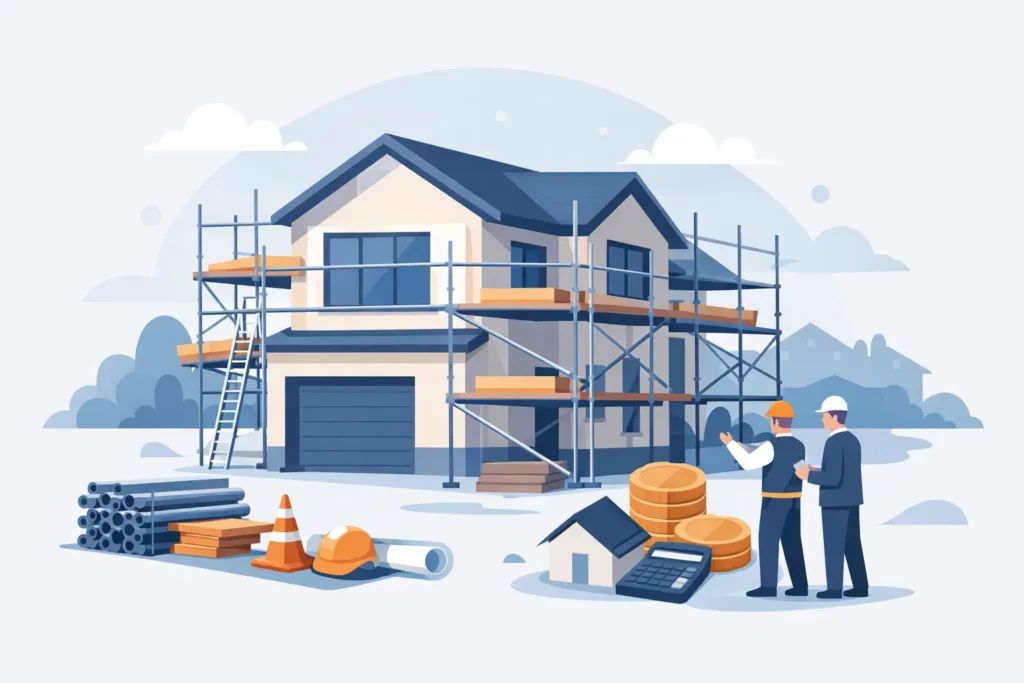
If you are repainting a landed home and the quote suddenly jumps once exterior access is discussed, scaffolding is usually the reason. The scaffolding cost for a landed house can be a meaningful part of the budget, especially in projects involving full exterior painting, crack repairs, roofline touch-ups, or hard-to-reach facade work. For most homeowners, the real question is not just price. It is whether the cost is necessary, fair, and tied to a faster, safer job with fewer delays.
That is the right way to look at it. Scaffolding is not a decorative line item. It affects access, safety, speed, workmanship, and how smoothly the whole project runs.
What drives scaffolding cost for a landed house
There is no single flat rate that applies to every property. A compact terrace house with simple front access is very different from a large detached home with side setbacks, uneven ground, and multiple roof levels. That is why serious contractors usually prefer a site assessment before confirming pricing.
The first driver is house type and size. A small inter-terrace home generally needs less scaffold material and less setup time than a corner terrace, semi-detached, or bungalow. The more elevation that must be accessed, the more the cost rises.
The second driver is height. A two-story house is straightforward compared with a three-story property with high parapet walls, attic sections, or double-volume spaces. Higher access usually means more scaffold sections, more bracing, and stricter safety planning.
The third driver is the working area. Some projects only require front facade access. Others need the full perimeter, including side walls, rear elevations, ledges, and narrow service areas. Full-wrap access costs more, but it also allows the painters or repair team to work continuously without stopping and repositioning equipment every few hours.
Access conditions also matter more than many owners expect. If the scaffold crew can unload and install directly from an open driveway, setup is faster. If materials must be hand-carried through a tight side path, or if the ground is sloped, soft, or obstructed by landscaping, labor time increases.
Then there is the project duration. Some scaffold charges are based partly on how long the structure must remain on site. A quick repainting job may need it for only a short period. If the scope includes patching, waterproofing, detailed trim work, or staged repairs, rental duration can stretch, and so does the total cost.
Typical pricing expectations
In practical terms, scaffolding for a landed home is often quoted as part of the full exterior works rather than treated as a standalone purchase. That is usually better for the homeowner because it reduces finger-pointing between separate vendors. One contractor handles access, preparation, painting, touch-ups, and removal in one workflow.
As a broad expectation, homeowners often see scaffold costs ranging from a modest add-on for partial frontage access to a much larger sum for full-house access on taller or more complex properties. The range can be wide because site conditions vary so much. A quote that looks high at first glance may still be reasonable if it includes complete perimeter setup, safety measures, delivery, installation, dismantling, and the time needed to keep the scaffold in place for the full job.
The opposite is also true. A cheaper quote may only cover part of the house or may assume simpler access than what is actually on site. That creates friction later when variation charges appear.
This is why the cheapest number is rarely the best number to compare. Scope is what matters.
When scaffolding is worth paying for
Not every landed house job needs full scaffolding. For minor touch-ups, localized repairs, or low-height areas, ladders or mobile platforms may be enough. But once the work involves broad exterior painting at height, scaffolding usually becomes the more practical choice.
There are three reasons.
First, quality control improves. Painters can work on a stable platform at the right distance from the wall, which helps with surface preparation, crack treatment, sealing, and even paint application. Fine details around eaves, fascia boards, and upper walls are easier to complete properly.
Second, the job moves faster. Constantly shifting ladders slows production and creates stop-start momentum. A properly installed scaffold allows a crew to progress across larger areas without interruption. If you want the project completed with minimal disruption, that efficiency matters.
Third, safety is simply better. Exterior work at height is not the place to cut corners. A contractor who plans access properly is usually the same kind of contractor who plans masking, surface protection, scheduling, and handover properly too.
What should be included in the quote
If you are reviewing scaffolding cost for a landed house, ask for clarity on scope before focusing on the number. A usable quote should state which elevations are covered, how many levels are included, whether the price includes delivery and dismantling, and how long the scaffold can remain on site.
It should also be clear whether the cost is bundled into the painting contract or priced separately. Bundled pricing is often cleaner because it reduces administrative back-and-forth and helps lock in a fixed project figure once the scope is confirmed.
Homeowners should also check whether protective measures are accounted for. If the scaffold will be installed near parked vehicles, gates, landscaping, glass, or neighboring boundaries, the contractor should already be thinking about protection and logistics, not improvising after work begins.
Why painting projects often reveal the real scaffold need
A lot of owners first ask about scaffold pricing only after deciding to repaint the exterior. That makes sense, because painting exposes the full access challenge. Once the crew starts preparing walls, they may uncover hairline cracks, peeling sections, failed sealant, or weathered areas under ledges and roof edges. Those defects are hard to address properly without stable access.
This is where an end-to-end contractor has an advantage. Instead of arranging one vendor for scaffold and another for painting, you get a single team managing the sequence. Setup happens, surface prep begins, patching is completed, sealer and top coats are applied, final touch-ups are checked, and dismantling is scheduled once the work is truly finished. That saves time and cuts down on coordination mistakes.
For homeowners who want predictable execution without lifting a finger, process matters as much as price.
How to compare quotes without getting misled
A smart comparison starts with the same scope across all contractors. If one quote includes only the front facade and another includes all external walls, they are not comparable. If one allows only a few days on site and another includes enough duration for prep and drying time, they are not comparable either.
Ask what happens if the project runs longer because of weather or added repair work. Some contractors build in reasonable flexibility. Others charge extra the moment the schedule shifts. Neither approach is automatically wrong, but you should know which model you are buying.
You should also look at who is responsible for the full job. A contractor with an in-house team and a defined workflow usually offers better accountability than a loosely assembled group of subcontractors. When one party owns the timeline, quality checks, and final handover, problems tend to get solved faster.
A simple way to budget for it
If your landed home needs full exterior repainting, treat scaffolding as part of the project cost, not an optional extra you hope to avoid. That mindset leads to more realistic budgeting and fewer last-minute surprises.
Start with a site-based quotation rather than relying on rough online estimates. Then check whether the access plan matches the work scope. If your contractor is promising fast mobilization, proper prep, multi-coat application, cleanup, and a warranty-backed finish, the scaffold setup should support that promise rather than conflict with it.
That is the standard we believe in at Painting.com.sg. Clear scope, fixed pricing once confirmed, and a workflow built to finish the job quickly with minimal disruption.
The real question is not just cost
The real question is whether the scaffolding helps you get a safer project, better workmanship, and a cleaner finish without delays or repeated access problems. On a landed house, exterior work is only as efficient as the access behind it. If the setup is right, everything after that tends to move faster and with less stress.
When you review a quote, do not ask only, “How much is the scaffold?” Ask, “What does this allow the contractor to do properly?” That is usually where the best value shows up.
